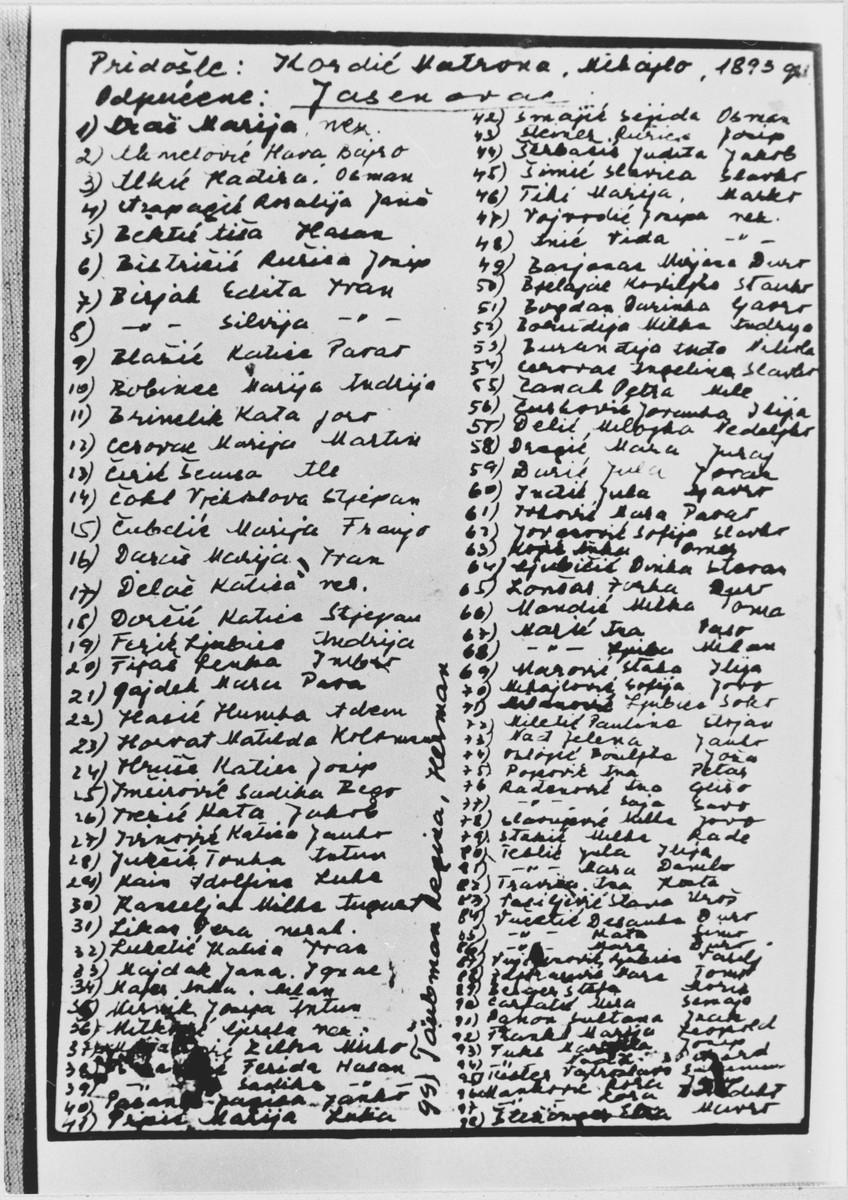
"Commissioner" Josip Abel appointed to a Jewish firm reports to regional authorities
Translated version
here
Themes: Expropriation


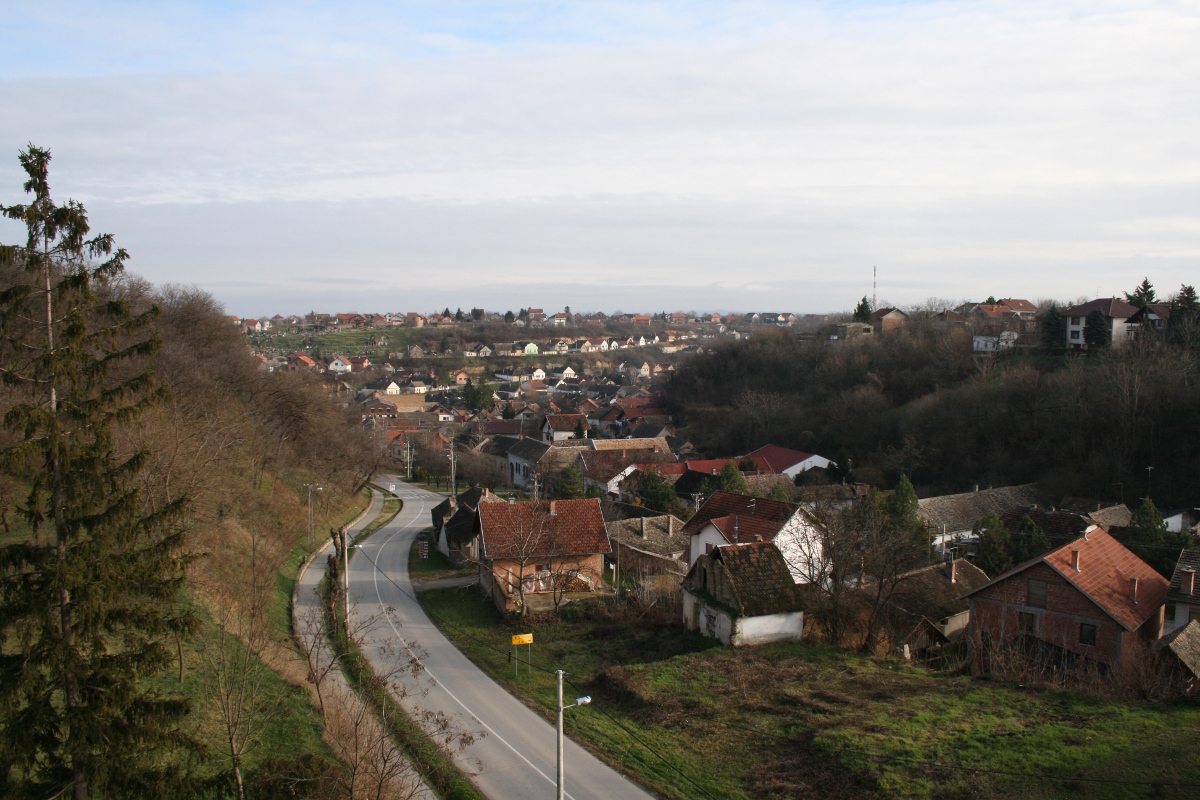
A small town of around 5,800 inhabitants in 1931, Ilok was home to 304 practitioners of Judaism in 1921, increasing to 320 in 1931. Comparing the census data from the Kingdom of Yugoslavia with the information from Ilok's Jewish community and other sources, counting also people who did not declare Judaism as their faith but would nevertheless be considered Jews under Ustaša racial laws, Melita Švob reached a population of 397 Jews in 1940, which corresponds more closely with postwar testimonies.
Ilok was among the most important centers of Orthodox Judaism in eastern Croatia, although the town was home to non-Orthodox practitioners as well. The synagogue and the Jewish cemetery were established around 1870. In the subsequent decades, the community founded a confessional school, named "Talmud Tora." A Zionist organization was created in 1919. In 1925, after serious disagreements over the kind of ritual that was to be used in the local synagogue, requiring an intervention of the Upper Rabbinate of Belgrade, the community divided into a smaller Sephardic community organization and a larger Ashkenazi one. As part of the division agreement, the Ashkenazi organization received the synagogue, while the Sephardic one received the Jewish school across the street, part of which they converted into a second temple.

A sampling of articles from Ilok's newspaper Narodna Sloga in early to mid 1920s shows a clear presence of antisemitism in the interwar period. In one article, local Jews are attacked for "enriching themselves at the expense of local Christians" and for promoting "their rigid separatism and Jewish chauvinism." In another, they are accused of "boycotting us Christians, our national and humanitarian associations and events, and our social life in general."
After the Axis occupying powers created the Independent State of Croatia and installed the Ustaša movement in power on April 10, 1941, the Jewish community of Ilok was subjected to the same measures of persecution as all the other Jewish communities across the new state. In the end of April 1941, mere weeks after Ustaša takeover, all Jewish men were imprisoned in the District's municipal building. Soon after, they were transferred to the synagogue and interned there. Local Ustaša authorities ordered the community to collect two million Yugoslav dinars, twelve kilograms of silver, and one kilogram of gold to secure the release of their fathers, husbands, and sons. The community complied. After their release, the authorities forced the men and other members of the community to participate in forced labor squads, which involved frequent beatings and other forms of humiliation.
On July 11, 1941, the District Prefect Franjo Mikulandi informed the State Directorate of Economic Reconstruction in Zagreb that he had formed a commission of "three politically most reliable persons" to handle regime directives in Ilok, including Antun Matković, Josip Šarinić, and Eugen Metzing, whose authority extended to the town of Ilok and villages of Šarengrad, Mohovo, Molovin, Sot, Neštin, and Susek. He also formed the District Commission of the State Directorate of Economic Reconstruction, which dealt with deportations and expropriations, naming Eugen Metzing and a retired teacher Jakov Mađarević as commissioners. As the establishment of Ustaša Croatia's ethnic German Volksgruppe required, local ethnic Germans were duly included in the new governing structures.
Other notable representatives of Ustaša authority in Ilok, many of them leading members of the local cell of the movement were Dr. Branko Sušić, Tunja (Antun) Matković, Josip Šarinić, Vlatko Filipović, Gustav Erber Jr., Vlado Kocijan, Mirko Kovačić, and Gašpar Grgoković, who replaced Franjo Mikulandi as District Prefect in mid-1943. Beside Eugen Metzing, notable figures in the local Volksgruppe were Ferdinand Knizl, Vili Keler, and Julije Nimrihter.
Mikulandi's 11 July 1941 report also informed the authorities in Zagreb that he had determined the location of Ilok's temporary concentration camp, an abandoned building formerly a wool mill, "with a large, fenced yard and potable water," "able to receive 400 people for transitional stay." Mikulandi indicated that the revenue office in Ilok had in its possession "260.000 dinars of confiscated Jewish money," some of which he indicated would be used to fix up the temporary concentration camp. Until the establishment of the 'wool mill concentration camp,' the synagogue served the purpose of a temporary site of internment.
Interestingly, Mikulandi's report also noted that local peasants, ostensibly Croats and Germans, did not want to take the livestock from households that the Ustaša authorities deported—belonging mainly to the many forcibly deported Serbs, but ostensibly also to some rural Jews—asking the State Directorate of Economic Reconstruction to organize a sale of said livestock as soon as possible. This remark represents a rare glimpse into the evidently negative attitudes of non-Serb and non-Jewish peasants toward the violent deportations of their former neighbors.

Ilok's local Ustaša killing site was a place named "Lovka" on the banks of the Danube River, mentioned in many postwar perpetrator and other witness testimonies. No data exists for smaller-scale murders of Ilok's Jews, but it is possible that some members of the community were murdered locally before the mass deportation in July 1942, as was the case in nearby towns of Vukovar, Šid, and others. "Lovka" continued to serve as a mass killing site after the deportation of Ilok's Jews as part of the Ustaša genocide against Serbs.
Various forms of persecution and incessant harassment continued until July 27, 1942, when the great majority of Ilok's Jews regardless of gender or age were "deported" from the town. Josip Weiss, Leo Ganz, and Rudolf Vales died already during the inhumane transport. Ustaša authorities first interned part of the community in the concentration camp at the nearby town of Šid and another part in the concentration camp Cibalia, former stadium of a soccer club of the same name in the town of Vinkovci. This deportation action encompassed not only Jews from the town of Ilok, but also the few dozen scattered across the rest of the Ilok District, including villages of Susek, Šarengrad, Neštin, and Sot, as well as Jewish inhabitants from surrounding municipalities of Bingula, Čerević, Monoštor, Erdevik, and Molovin.
Members of the community interned in concentration camp Cibalia were soon joined by those first taken to the concentration camp in the town of Šid. Three weeks after the deportation from Ilok, the Ustaša authorities forced all of Ilok's Jews into boxcars and transported them from concentration camp Cibalia in Vinkovci to Zagreb, where those deemed strong enough to work were assigned to forced labor in Germany. Everyone else was taken to Jasenovac death camp.
None of the deported Jews returned or were ever heard from again, either from Germany or from Jasenovac death camp. Only fifteen Jews from Ilok survived the Holocaust, including Salomon Davidovitsch, Anna Deutsch, Blanka Deutsch, Hugo Epstein, Eugenie Fried, Frieda Fried, Mavro Fried, Josef Klein, Gisela Mandel (born Kaff), Lea Stein (born Kaff), Frieda Stern, Leopold Stern, Marko Stern, Eugen Weiss, and Laza Winternitz. Today, there is no Jewish community in Ilok.
- Melita Švob. Židovi u Hrvatskoj (Zagreb, 2004).