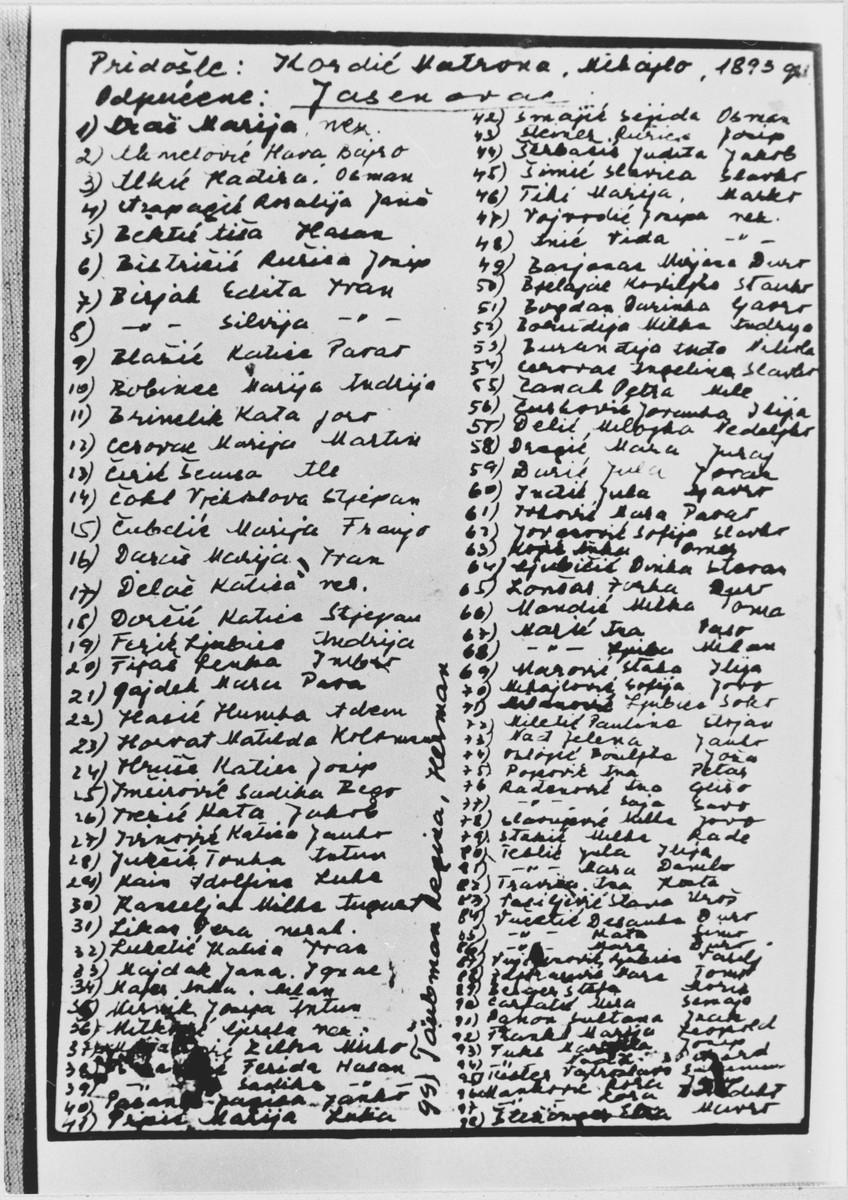
Testimony of Makso Pšerhof about the persecution of Jews in Križevci
Translated version
here
Themes: Voices of the Victims


The town of Križevci, located in northwestern Croatia, experienced one of the earliest and most radical implementations of anti-Jewish persecution in the Independent State of Croatia (Nezavisna Država Hrvatska, NDH). Before the Second World War, Križevci's Jewish community had been small but well integrated. Jews were active in the town's civic and economic life, and antisemitism among the general population has reportedly been relatively weak.
After the invasion of Yugoslavia by the Axis forces, German forces entered Križevci on 10 April 1941. They however, withdrew from the town almost immediately, leaving local actors to seize control. A small circle of Ustaša members and sympathizers among the town's elite, including judges, lawyers, clerks, priests, and teachers, quickly organized themselves and seized power. They immediately began implementing antisemitic policies even before the NDH government in Zagreb had issued nationwide anti-Jewish legislation.
Immediately after taking power, the new authorities in Križevci began confiscating property from Jews and Serbs. Police officers went door to door, seizing radios, bicycles, cameras, and other valuables. Soon after, they introduced a "contribution," a forced payment imposed on Jews. By mid-April, Ustaša officials had begun taking over Jewish-owned businesses through so-called "commissioners," who in practice stripped owners of their livelihoods. The Križevci synagogue was turned into a storage site for looted belongings, and eventually into a makeshift auction hall where people could buy confiscated furniture and household goods. Even the local Catholic Church took some of the synagogue's furnishings for its own use.
Forced labor soon followed. By May 1941, nearly all Jews in Križevci, including men, women, children, and the elderly, were required to perform heavy daily work, cleaning streets, unloading cargo, and maintaining public spaces. They were marked with a yellow badge weeks before such measures were introduced in Zagreb and restricted by curfews that limited their movement. These measures served both to humiliate the Jewish community and to keep it under constant supervision.
The most decisive phase began in July 1941, when the central NDH authorities ordered the deportation of Jews and Serbs to the Gospić–Jadovno camp system. Križevci's officials responded immediately. On 31 July, after returning from forced labor, all Jewish men between the ages of sixteen and sixty were arrested without warning. They were told they were being sent to work on road construction but were in fact being deported to a network of death camps. Early the next morning, thirty-six Jewish men from Križevci were transported to Zagreb and then the majority was sent toward Gospić, where most were murdered. A few survived through escape or by receiving rare permissions to leave for the Italian occupation zone.
Women, children, and the elderly who remained in Križevci continued to face severe restrictions. Their homes were seized, and many were moved into overcrowded dwellings on the town's outskirts. As the Jasenovac camp system expanded later in 1941 and 1942, deportations resumed. By the end of 1942, almost the entire Jewish population of Križevci and its surrounding district had been deported. Only a handful survived.
The swiftness and eagerness in the persecution of Jews in Križevci was enabled, among other factors, by the town's small size and overwhelmingly Croatian population which made it possible for the Ustaša elite to consolidate control quickly. Their close proximity to Zagreb made coordination with central agencies easier, especially when they needed logistical support for deportations. Most importantly, the local leadership was ideologically committed and internally unified.
Before the war, around 110 Jews lived in Križevci, although the number of people persecuted as Jews under racial laws was somewhat higher. After the Holocaust, only about 29 were alive. A community that had been present for generations, was nearly wiped out in the span of little more than a year.
- Renee Weisz-Maleček. Židovi u Križevcima (Zagreb: Židovska općina Zagreb, 2012).
- Ljiljana Dobrovšak i Dena Pernjak. Židovi u Križevcima: povijest, značaj i naslijeđe (Križevci: Gradski muzej Križevci, 2015).